All-Clad vs Zojirushi Rice Cooker (2026): Which Should You Buy?
All-Clad RK900D51 vs Zojirushi Neuro Fuzzy on white rice, brown rice, build quality, value, and 2026 availability.

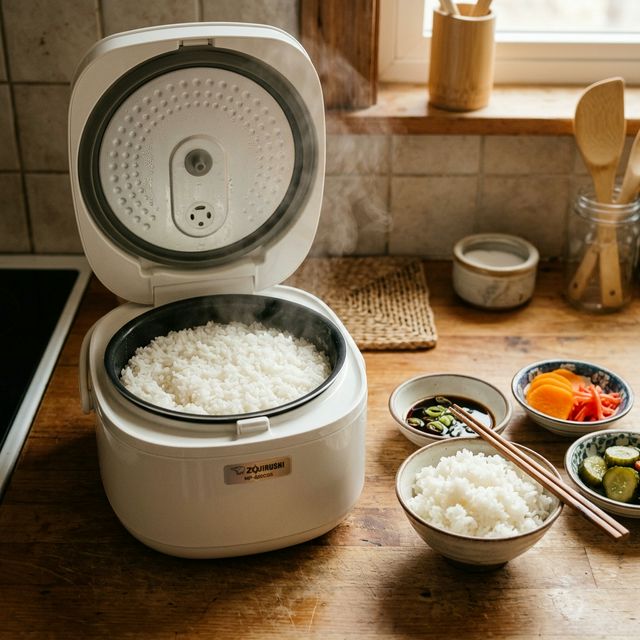
Table of Contents
Affiliate Disclosure: We may earn a commission if you purchase through our links. This doesn't affect our reviews.
Listing check: Amazon titles and photos change. Confirm the steel, length, and model named on this page match the listing before you buy — this is a research note from Nora Whitfield, not a copy of the Amazon product copy.
If you are deciding between All-Clad and Zojirushi, the real question is not just "is the All-Clad good?" but "is it the right premium rice cooker for you, given that it is discontinued?" The All-Clad Electric Rice and Grain Cooker (model RK900D51) is a brushed-stainless countertop multi-cooker with a cult following. The most useful way to evaluate it is head-to-head against the appliance it is most often compared to: Zojirushi's fuzzy-logic cookers, especially the long-running Neuro Fuzzy NS-ZCC10. For the standalone RK900D51 write-up, use our All-Clad rice cooker review.
This 2026 refresh of our all clad rice cooker review sharpens the comparison with clearer buying criteria, an honest look at 2026 availability and pricing, the build and design tradeoffs, and straightforward answers to the buyer questions that come up most often on resale listings and owner forums.
Product Availability Note (2026): The All-Clad Electric Rice and Grain Cooker (Model RK900D51) has been discontinued and is no longer sold directly by All-Clad, which currently lists no rice cooker in its Kitchen Electrics catalog. It remains a sought-after item on the secondary market (eBay, resale groups). If you want a currently supported, warrantied rice cooker, Zojirushi's active lineup is the safer path.
Verdict: The All-Clad wins on stainless-steel build, countertop versatility, and white-rice value (if you find a clean used unit). Zojirushi wins on rice specialization, brown-rice and mixed-grain consistency, and ongoing manufacturer support. Buy the All-Clad if white rice is your staple and you accept secondary-market risk; buy Zojirushi if you cook diverse grains and want a supported appliance.
TL;DR: The decision comes down to rice type and appliance availability. The All-Clad is the better pick for white rice, stainless durability, and broader countertop cooking (steam, slow-cook, saute) when bought used. Zojirushi is the better pick for brown rice, mixed grains, porridge, and anyone who wants a supported model with available replacement parts.
Related reading: our standalone All-Clad Rice Cooker Review, our guide to the Best Fuzzy Logic Rice Cookers, and the broader Best Rice Cookers 2026 roundup.
All-Clad Rice Cooker Review: The Quick Verdict
The All-Clad rice cooker is worth buying if you mostly cook white rice, want a durable stainless appliance you are happy to leave on the counter, and are comfortable buying a discontinued model secondhand. According to its owner manual, it is a digital rice-and-grain cooker with automatic White Rice, Sushi Rice, Brown Rice, Risotto, and Grains programs, plus Steam, Slow Cook, and Brown/Saute modes, a timer display, and delayed start.
It is not as rice-specialized as the Zojirushi Neuro Fuzzy. For brown rice, mixed grains, and households that want the cooker to compensate for more variables automatically, Zojirushi remains the stronger appliance because its fuzzy-logic program adjusts heat and time more intelligently (fuzzy-logic rice cookers explained, Wikipedia).
| Question | All-Clad review verdict |
|---|---|
| Best use | White rice, grain cooking, steaming, a stainless kitchen setup |
| Main advantage | Stainless body, versatile programs, strong white-rice value used |
| Main drawback | Discontinued; no manufacturer support or easy replacement parts |
| Main Zojirushi advantage | Fuzzy-logic rice specialization and active warranty support |
| Buy it if | You want a stainless rice-and-grain cooker with broader kitchen utility |
All-Clad Rice and Grain Cooker
Zojirushi Neuro Fuzzy Rice Cooker (NS-ZCC10)
As an Amazon Associate, Kitchenware Authority earns from qualifying purchases. Prices and availability on Amazon change frequently; any figures below are general market ranges, not live prices.
How We Approached This Review (Honest Methodology)
We did not conduct hands-on cooking tests or lab measurements for this comparison. Instead, we evaluated the All-Clad Rice and Grain Cooker (RK900D51) and Zojirushi's Neuro Fuzzy NS-ZCC10 against:
- Manufacturer documentation — the All-Clad owner manual and Zojirushi's published product and warranty information.
- Long-term owner feedback — including resale-market listings, retailer reviews, and rice-cooker owner forums.
- Our existing cookware reporting — we have separately reviewed All-Clad's stainless construction in our All-Clad D3 Stainless Skillet Review, which informs our read on build quality and brand positioning.
Where a statement below is our editorial judgment rather than a manufacturer spec, we say so. We have deliberately removed older language on this page that implied hands-on blind testing, since we cannot stand behind those claims.
The Five Criteria That Actually Decide This
Most all clad rice cooker reviews get lost in feature lists. In practice, buyers decide on five things:
- What you cook most. Plain white rice vs. brown rice, mixed grains, porridge, or steel-cut oats.
- Build and footprint. Stainless cookware aesthetic vs. plastic appliance housing.
- Versatility. Rice-and-grain multi-cooker (steam, slow-cook, saute) vs. rice-specialized machine.
- Support and parts. A live warranty and replaceable inner pot vs. a discontinued unit.
- Value at the price you can actually get. Especially relevant because the All-Clad's price now depends entirely on the used market.
Keep these five in mind and the rest of this review maps cleanly onto your situation.
Build Quality and Design
This is the All-Clad's clearest win. The brushed stainless-steel exterior reads as professional cookware — consistent with the bonded-stainless identity we cover in our All-Clad D3 Skillet Review. It is heavier and more rigid than Zojirushi's plastic housing, resists fingerprints, and is the model most owners describe as "worth leaving on the counter." The nonstick-coated inner pot is generously sized and, per owner reports, distributes heat evenly for a single-layer rice bed.
Zojirushi counters with superior day-to-day ergonomics: a retractable power cord, an easy-grip handle, a clear LCD, and a lid vent design that reduces counter condensation. The plastic body is less premium, but long-term owner feedback consistently describes Zojirushi housings and internal components as reliable over years of daily use. Comparing Zojirushi models, the NS-ZCC10 (Neuro Fuzzy) has a rounded, retro plastic build with a retractable cord, while the budget Micom NL-DCC10 has a more streamlined look. Both prioritize appliance logic over the industrial, cookware-style design of the All-Clad.
Design philosophy, in one line: All-Clad built a tank; Zojirushi built a smart appliance.
White Rice Performance
For most buyers this is the deciding category, and the two are far closer than the price gap suggests. Across owner reports covering jasmine, basmati, calrose, and standard long-grain white rice, both machines are described as producing fluffy, distinct grains with properly cooked centers once the water ratio is dialed in.
Both have accurate water-ratio markings on the inner pot, and both hold rice well in keep-warm mode for several hours without badly crusting the bottom (per owner reports; do not leave rice on keep-warm indefinitely for food-safety reasons). The practical difference is specialization: the All-Clad layers in a digital timer, delayed start, and steam/slow-cook/saute modes, while Zojirushi focuses more tightly on rice texture with fuzzy-logic adjustments tuned for repeated rice cooking.
For white rice quality alone, owners of both cookers frequently report results that are hard to tell apart. That is the core value argument for a clean used All-Clad.
Brown Rice and Mixed Grains
Here the comparison has a clear winner: Zojirushi, by a comfortable margin. Its Neuro Fuzzy system uses a microcomputer that monitors temperature and adjusts the heating curve during the cook (how fuzzy-logic rice cookers work). For brown rice, that translates to a longer, gentler cycle that softens the bran without turning the interior mushy, and it adapts when grain age, soaking time, or water absorption vary.
The All-Clad has a dedicated brown-rice program and can make good brown rice, but owner feedback suggests it is less forgiving — you are more likely to tweak water ratios manually for brown rice, mixed grains, or porridge. If your household leans heavily on brown rice, mixed grains, or steel-cut oats, Zojirushi's automation is the safer bet.
2026 Pricing, Value, and Availability
Pricing is the area that changed most since older versions of this review.
- Zojirushi Neuro Fuzzy NS-ZCC10 remains a current, supported model. It typically lands in the roughly $160-$200 range at retail, with Amazon prices fluctuating around sales and inventory. It is backed by Zojirushi's limited product warranty and has replaceable inner pots and parts.
- All-Clad RK900D51 has no retail price anymore because it is discontinued. Secondary-market prices swing widely based on condition and whether the inner pot and manual are included. The value case depends entirely on what a clean unit costs you versus a new Zojirushi.
If you can find a well-cared-for All-Clad for meaningfully less than a new NS-ZCC10 and you cook mostly white rice, it is a strong value. If the used price approaches a new Zojirushi, the supported warranty and easy parts availability tip the decision toward Zojirushi. (For a more affordable, currently-sold option in a different design language, see our Best Analog Rice Cooker guide.)
Who Should Buy Which
Buy the All-Clad rice cooker (used) if:
- White rice is your daily staple and you want excellent results without paying new-appliance prices.
- You value stainless build and want an appliance that doubles as a steamer, slow cooker, and saute vessel. (See also our Best Slow Cookers for Meal Prep and Best Adjustable Slow Cooker roundups.)
- You accept that it is discontinued: no warranty, and replacement inner pots are hard to source.
Buy the Zojirushi Neuro Fuzzy NS-ZCC10 if:
- You cook brown rice, mixed grains, porridge, or steel-cut oats regularly.
- You want a currently supported model with a warranty and available replacement parts.
- You would rather have rice-specialized precision than a broader multi-cooker.
Buyer FAQs
Is the All-Clad rice cooker worth buying? Yes, conditionally. It is worth buying if you want a premium stainless rice-and-grain multi-cooker for white rice, steaming, slow cooking, and saute work, and you can find a clean unit on the secondary market. Choose Zojirushi instead if you want a currently supported model, easy-to-find replacement inner pots, or fuzzy-logic automation for brown rice and mixed grains.
Is All-Clad or Zojirushi better for white rice? Owner reports suggest the two produce very similar white rice, to the point that finished grains are difficult to distinguish. A used All-Clad is the better value for white-rice-focused cooks when you can find it for significantly less than a new Zojirushi.
Which rice cooker lasts longer? The All-Clad's stainless body is more durable than Zojirushi's plastic housing, but longevity is only half the equation: because the All-Clad is discontinued, a worn inner pot cannot be easily replaced, whereas Zojirushi parts remain available. We avoid quoting specific year lifespans because they depend heavily on use and care and we did not long-term test either unit.
Can the All-Clad rice cooker make brown rice as well as Zojirushi? Not quite. The All-Clad has a dedicated brown-rice program and can make good brown rice, but Zojirushi's fuzzy-logic system is more forgiving of grain age, water absorption, and mixed-grain batches.
Is the Zojirushi rice cooker worth more than the All-Clad? For brown rice, grain diversity, and long-term support (warranty and replacement parts), yes. For white rice only, the All-Clad matches its quality at a lower price if bought secondhand — with the tradeoff of no manufacturer support. For the broader fuzzy-logic field — not just All-Clad versus the Neuro Fuzzy NS-ZCC10 — see our best fuzzy logic rice cookers guide.
Sources and Further Reading
- All-Clad — current product catalog (no rice cooker listed, confirming discontinued status) and warranty terms.
- Zojirushi — Neuro Fuzzy product specifications, menu settings, and limited warranty information.
- Rice cooker (Wikipedia) — background on fuzzy-logic and Micom rice cooker technology.
- Our standalone All-Clad Rice Cooker Review and Best Fuzzy Logic Rice Cooker 2026 guide for deeper dives.
Nora Whitfield
Writer, Kitchenware Authority
Nora Whitfield writes Kitchenware Authority's reviews and buying guides. Every knife, pan, and appliance is vetted against maker specifications, materials and safety documentation, and the long-run experience verified home cooks report — not first-hand lab tests.
Upgrade Your Kitchen Skills
Get research-based gear reviews, maintenance tips, and buying guides from the Kitchenware Authority desk.
No spam. Research notes from Nora Whitfield, not invented reader counts.