Best Stand Mixers for Home Bakers in 2026
From the iconic KitchenAid to budget-friendly options, we compare the best stand mixers for every type of home baker.

verified Chef Tested
Hands-on tested by professional chefs
toc Table of Contents
Affiliate Disclosure: We may earn a commission if you purchase through our links. This doesn't affect our reviews.
A good stand mixer is the backbone of any serious home bakery. It kneads bread dough when your arms give out, whips egg whites to stiff peaks in seconds, and churns through batch after batch of cookie dough without complaint. It’s a one-time purchase that lasts decades.
But choosing the right one involves navigating a confusing range of motors, bowl sizes, and price points. Here’s our guide to the best stand mixers available in 2026.
What to Look for in a Stand Mixer
Motor Power
Motor wattage tells you how much electrical power the mixer draws, but torque is what actually matters for mixing. A well-geared 325-watt motor (like KitchenAid’s) can outperform a poorly-geared 500-watt motor. That said, for heavy bread doughs and double batches, more wattage generally helps.
Bowl Size
- 4.5-5 quart: Perfect for most home baking. Handles up to 9 cups of flour.
- 6-7 quart: For serious bakers who make multiple loaves or scale recipes up regularly.
- 3.5 quart: Compact options for small kitchens and light baking.
Mixing Action
- Planetary mixing (beater orbits the bowl): Most thorough coverage. Used by KitchenAid, Cuisinart, and most others.
- Counter-rotating (bowl and beater rotate in opposite directions): Used by Ankarsrum. Exceptional for dough.
Build Quality
All-metal gears and direct-drive motors outlast plastic gears. The KitchenAid Artisan’s all-metal gear train is why vintage models from the 1990s still work perfectly today.
Our Top Picks
1. Best Overall: KitchenAid Artisan 5-Quart
The KitchenAid Artisan is the most popular stand mixer in America for good reason. Its 59-point planetary mixing action provides thorough, even mixing. The 325-watt motor handles everything from delicate meringues to stiff cookie dough. And the power hub on the front accepts 10+ attachments — pasta rollers, meat grinders, ice cream maker, spiralizer, and more.
Available in over 40 colors, the Artisan is as much a kitchen design statement as it is a baking tool. It’s heavy (26 lbs), built like a tank, and backed by thousands of positive reviews spanning decades.
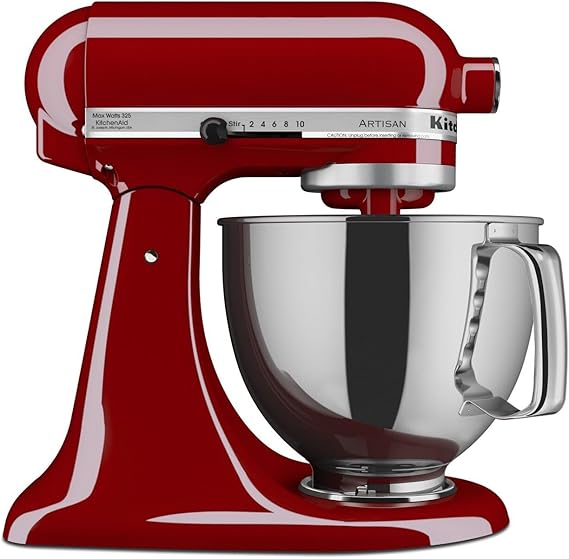
KitchenAid Artisan Series 5-Quart Tilt-Head Stand Mixer
KitchenAid
The undisputed icon of the home kitchen, versatile enough for everything from whipped cream to heavy bread dough.
KitchenAid Artisan 5-Qt
~$450
2. Best Value: Cuisinart Precision Master SM-50
The Cuisinart SM-50 offers 500 watts of motor power and a 5.5-quart bowl at roughly half the KitchenAid’s price. It handles heavy bread dough with less strain and includes a die-cast metal construction that feels premium. The tradeoff: fewer attachment options and lighter build.
If you primarily need a mixer that mixes well and aren’t interested in the KitchenAid attachment ecosystem, the Cuisinart delivers exceptional value.
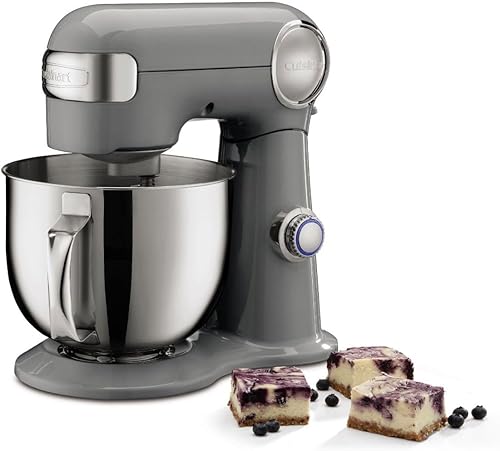
Cuisinart Precision Master 5.5-Quart Stand Mixer (SM-50)
Cuisinart
A feature-rich and powerful alternative to the classic KitchenAid at a competitive price point.
Cuisinart Precision Master SM-50
~$200
3. Best for Bread: Ankarsrum Original
The Swedish Ankarsrum takes a radically different approach: instead of the beater orbiting the bowl, the bowl rotates against a stationary roller and scraper. This counter-rotating action mimics hand kneading more closely than any planetary mixer, producing superior gluten development with less friction heat.
The Ankarsrum handles 5+ lbs of bread dough effortlessly — more than any other home mixer. It’s the choice for artisan bread bakers who make multiple loaves weekly.
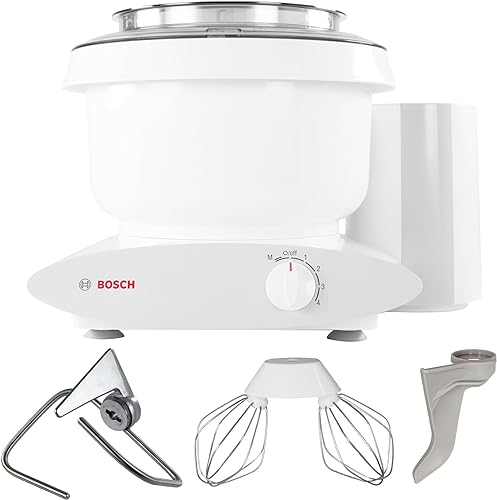
Ankarsrum Original Stand Mixer
Ankarsrum
The legendary Swedish mixer with a unique design where the bowl rotates, not the attachment.
4. Best Budget: Hamilton Beach Electric Stand Mixer
At under $100, the Hamilton Beach won’t compete with a KitchenAid on durability or attachment options, but it handles basic baking tasks competently. The 300-watt motor manages cookies, cakes, and moderate bread doughs. The splash guard is a nice touch.
For beginners who want to try stand mixing without a major investment, it’s a sensible starting point.
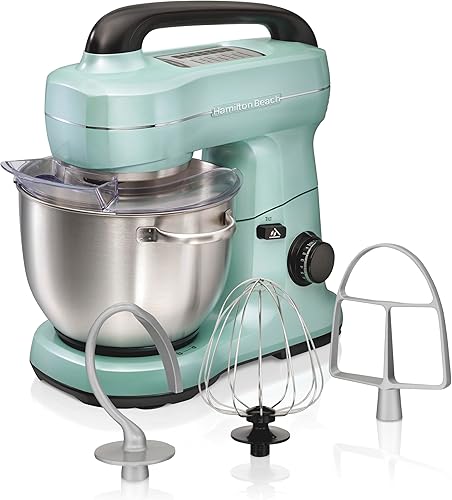
Hamilton Beach Electric Stand Mixer
Hamilton Beach
A budget-friendly mixer that provides essential features for occasional bakers.
Quick Comparison
| Mixer | Motor | Bowl | Best For | Price |
|---|---|---|---|---|
| KitchenAid Artisan | 325W | 5 qt | Best overall + attachments | ~$450 |
| Cuisinart SM-50 | 500W | 5.5 qt | Best value for power | ~$200 |
| Ankarsrum Original | 600W | 7 qt | Best for bread bakers | ~$650 |
| Hamilton Beach | 300W | 4 qt | Best budget option | ~$80 |
Stand Mixer Care Tips
- Don’t overfill. Exceeding the recommended flour capacity strains the motor and gears. Follow the manual’s guidelines.
- Start on low speed. Always begin mixing on speed 1 to prevent flour explosions and reduce wear on the motor.
- Let heavy doughs rest the motor. If you’re kneading for more than 8-10 minutes, give the mixer a 5-minute break to cool down.
- Clean after every use. Don’t let dough dry on attachments — it becomes concrete-hard.
- Store properly. Keep the mixer on a stable surface. The KitchenAid Artisan at 26 lbs is happiest on the counter permanently.
Our Recommendation
For most home bakers, the KitchenAid Artisan remains the standout choice. Its build quality, attachment ecosystem, and proven track record are unmatched. For budget-conscious bakers who don’t need attachments, the Cuisinart SM-50 delivers outstanding mixing at half the price. And for dedicated bread bakers, the Ankarsrum is worth every penny of its premium price.
More Kitchen Equipment: See our head-to-head KitchenAid vs Cuisinart comparison. Need a blender too? Check out the best blenders guide and Vitamix vs Blendtec.
Marcus Chen
Senior Kitchen Equipment Editor• Culinary Institute of America graduate • Former sous chef, Atelier Crenn SF • 3 years experience in Kyoto kaiseki kitchens
Marcus Chen is a professional cook and kitchen equipment specialist with 15 years of hands-on experience across restaurant kitchens in San Francisco and Tokyo. He has worked alongside Japanese bladesmiths in Sakai and Seki, trained in classical French technique, and spent three years cooking kaiseki in Kyoto. At Kitchenware Authority, Marcus leads all product testing and editorial standards — every recommendation passes through his kitchen before it reaches yours.
Upgrade Your Kitchen Skills
Get chef-tested gear reviews, maintenance tips, and exclusive buying guides delivered to your inbox.
Join 15,000+ home cooks. No spam, ever.