5 Accessories Every Knife Owner Needs
Beyond the blade: the essential accessories that keep your knives sharp, protected, and performing their best for years.

verified Chef Tested
Hands-on tested by professional chefs
toc Table of Contents
Affiliate Disclosure: We may earn a commission if you purchase through our links. This doesn't affect our reviews.
You bought a great knife. Now protect your investment. The right accessories prevent damage, extend edge life, and make cooking more enjoyable. Here are the five we consider essential, in order of priority.
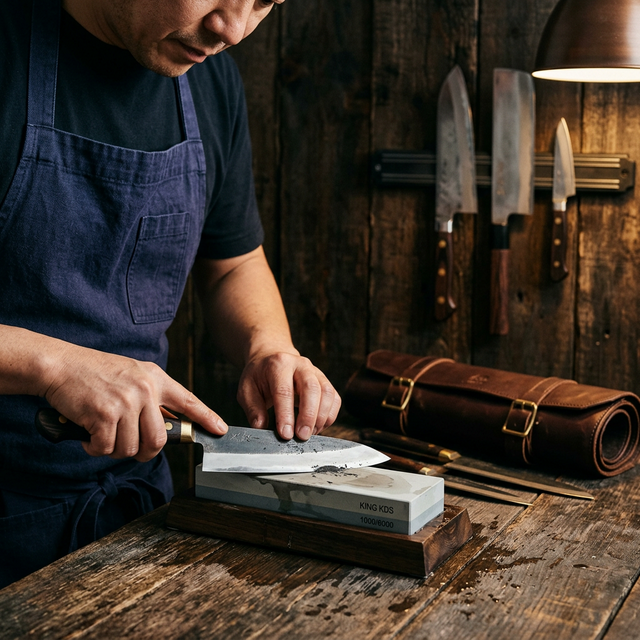
1. Whetstone (1000/6000 Combination)
Why it matters: No knife stays sharp forever. A whetstone is the only tool that can restore a truly sharp edge — honing steels and pull-through sharpeners can’t match it.
What to buy: A 1000/6000 combination stone is the only sharpening tool most home cooks need. The 1000-grit side does the actual sharpening; the 6000-grit side polishes and refines.
Our recommendation: The King KDS 1000/6000 ($25) is the most popular entry stone worldwide. It’s what culinary schools use to teach beginners. The Shapton Kuromaku 1000 ($35) is a slight upgrade with faster cutting and less soaking required.
How often: Every 2-4 weeks for daily-use knives. 10-15 minutes per knife. Learn the technique once and you’ll save hundreds on professional sharpening over a lifetime.
2. End-Grain Cutting Board
Why it matters: Your cutting surface directly impacts how long your edge lasts. Glass, granite, ceramic, and metal surfaces destroy knife edges instantly. Even bamboo (a popular “eco” option) is harder than most woods and dulls knives faster.
What to buy: An end-grain wood cutting board , ideally maple, walnut, or cherry. End-grain boards are constructed with the wood fibers pointing up, so the knife slips between the fibers rather than cutting across them. This is dramatically gentler on your edge.
Size recommendation: At least 18” × 12” for comfortable prep space. A large board makes cooking more enjoyable than you’d expect , you’re not constantly pushing food to the side.
Our recommendation: The Teakhaus by Proteak end-grain board ($80) is responsibly sourced, self-healing, and beautiful. For budget shoppers, the John Boos Maple Block ($50-70) is the American standard.
3. Magnetic Knife Strip
Why it matters: Tossing knives loose in a drawer is the fastest way to ruin your edges. Blades bang against utensils, other knives, and the drawer walls. A magnetic strip keeps each knife separated, visible, and instantly accessible.
What to buy: A 16-18 inch magnetic strip mounted on the wall. Look for:
- Strong neodymium magnets (not ceramic) that hold knives securely
- Wood or rubberized face to prevent scratching
- Mounting hardware included
Our recommendation: The Woodsom Walnut Magnetic Knife Holder (~$30) looks elegant and uses powerful rare-earth magnets. For a budget option, any stainless steel magnetic strip with a rubberized surface works well.
Alternative: If wall mounting isn’t possible, a knife block or blade guards are acceptable alternatives. Just never store knives loose in a drawer.
4. Ceramic Honing Rod
Why it matters: Between sharpening sessions, your knife edge doesn’t dull evenly , it bends microscopically at the tip. A honing rod straightens this micro-deformation, keeping the edge aligned and performing well between full sharpenings.
Important: Use a ceramic rod, not a traditional steel honing rod. Japanese knives use harder steel (60-67 HRC) than Western knives. A steel rod is too aggressive and can chip the edge. Ceramic is gentler and removes only a tiny amount of material.
How to use: Hold the rod vertically with the tip on a cutting board. Draw the knife down each side 5 times at your sharpening angle (15° for Japanese knives). Do this before each cooking session.
Our recommendation: The Idahone Fine Ceramic Rod 12” (~$30) is the professional standard for Japanese knife maintenance.
5. Knife Storage for Transport (Optional)
Why it matters: If you take your knives anywhere , to a friend’s house, a cooking class, camping , they need protection during transport. An exposed blade in a bag is dangerous and damages the edge.
Options:
- Edge guards / blade sheaths (~$3-5 each) , Simple plastic or felt-lined guards. Cheap and effective.
- Knife roll (~$30-60) , Canvas or leather roll that holds 3-7 knives. The professional choice for transporting a kit.
The Bottom Line
Total cost for the essential four: approximately $120-165. That’s a one-time investment that protects knives worth $100-500+ and keeps them performing at their best. The whetstone alone saves $15-25 per sharpening visit , it pays for itself in two sessions.
| Accessory | Priority | Cost | Lifespan |
|---|---|---|---|
| Whetstone 1000/6000 | Essential | $25-35 | 5-10 years |
| End-grain cutting board | Essential | $50-80 | 10+ years |
| Magnetic knife strip | Important | $25-40 | Lifetime |
| Ceramic honing rod | Important | $25-35 | 5+ years |
| Blade guards | Nice to have | $3-5 ea | 2-3 years |
Related Reading: Learn proper technique with our knife sharpening guide. Choosing your first blade? See how to choose your first chef knife and our top picks for home cooks.
Budget vs Premium Accessories
You don’t need to spend hundreds on accessories to maintain your knives well. A solid $25 whetstone combo (1000/3000 grit) handles most jobs. Magnetic knife strips from brands like Woodsom or Benchusch cost under $30 and protect edges far better than a cluttered drawer. The one place to invest is in a quality cutting board: end-grain maple or walnut boards are gentle on edges and last a decade with oil treatments every few months. Skip bamboo boards, which are harder than maple and dull blades faster despite their eco-friendly marketing.
Marcus Chen
Senior Kitchen Equipment Editor• Culinary Institute of America graduate • Former sous chef, Atelier Crenn SF • 3 years experience in Kyoto kaiseki kitchens
Marcus Chen is a professional cook and kitchen equipment specialist with 15 years of hands-on experience across restaurant kitchens in San Francisco and Tokyo. He has worked alongside Japanese bladesmiths in Sakai and Seki, trained in classical French technique, and spent three years cooking kaiseki in Kyoto. At Kitchenware Authority, Marcus leads all product testing and editorial standards — every recommendation passes through his kitchen before it reaches yours.
Upgrade Your Kitchen Skills
Get chef-tested gear reviews, maintenance tips, and exclusive buying guides delivered to your inbox.
Join 15,000+ home cooks. No spam, ever.