Ceramic vs PTFE Nonstick: Food Release and Durability
Ceramic vs PTFE nonstick compared for food release, durability, heat limits, and care — plus when a ceramic pan is the better buy.

Editorial Review
Independent, research-driven reviews by our editorial team
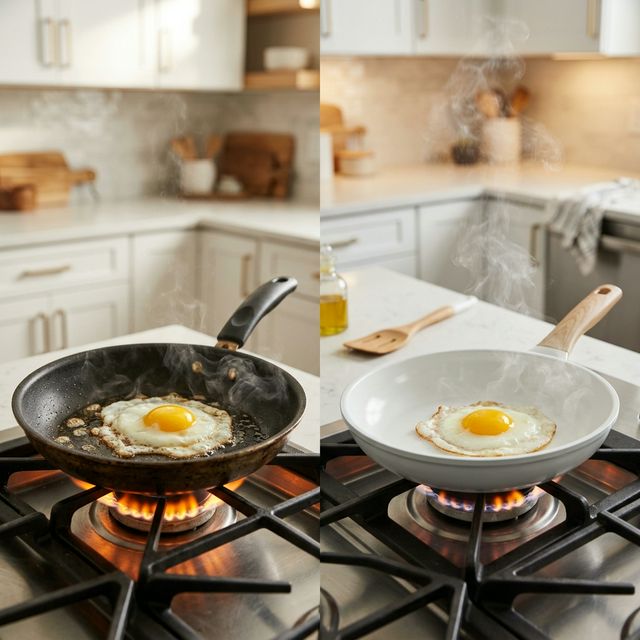
Table of Contents
Affiliate Disclosure: We may earn a commission if you purchase through our links. This doesn't affect our reviews.
Listing check: Amazon titles and photos change. Confirm the steel, length, and model named on this page match the listing before you buy — this is a research note from Nora Whitfield, not a copy of the Amazon product copy.
Are ceramic pans non stick? Yes, ceramic pans are genuinely nonstick when new. Eggs slide, pancakes release, fish fillets lift cleanly, and most cleanup takes a soft sponge. The problem is not whether ceramic works on day one. The problem is how long it keeps working.
In practical home use, ceramic pans often feel excellent early and then decline faster than PTFE pans. Eggs, pancakes, fish, and sticky sauces expose coating weakness quickly: once a ceramic skillet needs more butter or leaves egg film behind, its useful nonstick life is fading. That is the real ceramic-vs-nonstick tradeoff: ceramic gives you PFAS-free positioning, while PTFE gives you longer-lasting slickness when used within its heat limits.
Quick answer: Ceramic pans are non stick, but they are usually less durable than PTFE/Teflon nonstick pans. Buy ceramic if you want a PFAS-free coating and mostly cook eggs, fish, pancakes, and vegetables on medium heat. Buy PTFE if you want the slickest surface for the longest time and you are disciplined about low to medium heat.
For safety-specific detail, read are ceramic pans safe? and are ceramic non stick pans safe?.
What Counts as Nonstick?
Nonstick cookware is cookware with a surface designed to reduce food adhesion. The two common coated options are PTFE nonstick and ceramic nonstick.
PTFE is polytetrafluoroethylene, the fluoropolymer behind many Teflon-style coatings. It is very slick and tends to hold release longer than ceramic when used correctly.
Ceramic nonstick is usually a silica-based sol-gel coating applied over a metal pan. It is not solid ceramic pottery. It is an engineered coating that creates easy food release without using PTFE as the slick surface.
PFAS are a broad family of fluorinated chemicals. PTFE belongs to that broader chemistry family, while true ceramic nonstick is marketed as PFAS-free, PTFE-free, and PFOA-free.
Are Ceramic Pans Non Stick Enough for Eggs?
Yes. A new ceramic pan is nonstick enough for eggs, pancakes, crepes, delicate fish, and sauteed vegetables. If you preheat gently, add a small amount of fat, and avoid overheating, the release can be excellent.
However, ceramic is less forgiving as it ages. Once the surface develops residue, microscopic wear, or heat damage, eggs start sticking first. Scrambled eggs, fried rice, and sticky sauces are the early warning tests. If those foods need aggressive scraping, the coating is no longer doing much nonstick work.
For example, a newer ceramic pan can handle two fried eggs with a half teaspoon of butter and a silicone spatula. Once that same pan needs a tablespoon of fat and still leaves egg film behind, the practical nonstick life is fading. At that point, it can still cook vegetables, but it is no longer the pan to use for delicate eggs or fish.
For a dedicated lifespan breakdown, see how long ceramic pans stay nonstick.
Ceramic vs PTFE: Food Release Over Time
| Test | New ceramic | New PTFE | After 1 year, careful use |
|---|---|---|---|
| Fried eggs | Excellent | Excellent | PTFE usually wins |
| Pancakes | Excellent | Excellent | Similar if ceramic is cared for |
| White fish | Good to excellent | Excellent | PTFE usually wins |
| Stir-fry vegetables | Good | Good | Depends more on heat control |
| Sticky sauces | Fair to good | Good | PTFE usually cleans easier |
| Oil-free cooking | Possible when new | Easier | PTFE usually wins |
The key point: ceramic is nonstick, but PTFE is usually more consistently nonstick over the life of the pan.
The Safety Difference
Ceramic is popular because true ceramic nonstick avoids PTFE as the release coating. That matters to shoppers who want a PFAS-free pan. Modern PTFE cookware can also be safe for normal cooking, but it should not be overheated, broiled, or preheated empty on high heat.
Poison Control notes that PTFE-style coatings can release fumes if overheated. FDA and EPA materials also explain why PFAS questions need specificity: food-contact uses, cookware coatings, paper packaging, legacy PFOA, and environmental exposure are related but not identical topics.
Useful context:
- FDA: Authorized Uses of PFAS in Food Contact Applications
- FDA: Questions and Answers on PFAS in Food
- EPA: 2010/2015 PFOA Stewardship Program
- Poison Control: Protect Yourself From Teflon Flu
The practical rule is simple: use any coated nonstick pan on low to medium heat. If you want high heat, use stainless steel, carbon steel, or cast iron.
Head-to-Head Comparison
| Category | PTFE nonstick | Ceramic nonstick |
|---|---|---|
| New food release | Excellent | Excellent |
| Release after repeated use | Usually better | Usually declines faster |
| PFAS-free positioning | No | Yes, if genuine ceramic |
| High-heat tolerance | Avoid high heat | More forgiving, but still not ideal |
| Typical lifespan | 2 to 5 years | 1 to 3 years |
| Best foods | Eggs, fish, crepes | Eggs, fish, pancakes, vegetables |
| Best buyer | Wants durable slickness | Wants PTFE-free nonstick |
Why Ceramic Pans Stop Being Nonstick
Ceramic usually stops being nonstick for four reasons.
First, high heat accelerates coating wear. A ceramic pan can tolerate more heat than PTFE in some specifications, but that does not mean high heat is good for the coating.
Second, aerosol cooking sprays create residue. The sticky film bonds to the surface and makes the pan feel worn even when the coating is not deeply scratched.
Third, dishwasher detergent is harsh. Many ceramic pans are labeled dishwasher-safe, but hand washing keeps the surface slick longer.
Fourth, stacking and metal tools create surface damage. Ceramic is harder than PTFE at first, but chips and abrasion still shorten its life.
When to Choose Ceramic Nonstick
Choose ceramic if:
- You want a PFAS-free, PTFE-free coated pan.
- You mostly cook eggs, pancakes, fish, and vegetables.
- You use low to medium heat.
- You are comfortable replacing the pan sooner than PTFE.
- You want a pan that feels simpler for a shared household.
For ceramic-specific buying picks, see best ceramic nonstick pans and best ceramic cookware for gas stoves.
When to Choose PTFE Nonstick
Choose PTFE if:
- You want the slickest food release for the longest period.
- You cook a lot of eggs or fish.
- You never preheat coated pans empty.
- You do not use nonstick for searing or broiling.
- You want the best cost per year of nonstick performance.
PTFE is not the right answer for every cook, but it is still the performance benchmark for low-stick cooking.
When to Skip Coated Nonstick Entirely
Skip both ceramic and PTFE for:
- High-heat steak searing.
- Pan sauces that need fond.
- Broiling.
- Decades-long cookware value.
- Heavy metal utensil use.
Use stainless steel, cast iron, or carbon steel for those jobs. A strong kitchen usually has one coated nonstick pan for delicate foods and uncoated cookware for everything else.
Best Pans to Consider
Best PTFE value: T-fal Professional 12-Inch is inexpensive, slick, and easier to replace when worn.
Check current T-fal Professional 12-inch nonstick pan price
Best ceramic pick: GreenPan Valencia Pro is the ceramic pan we would start with if PFAS-free positioning matters more than maximum coating life.
Check current GreenPan Valencia Pro 12-inch ceramic pan price
Best ceramic design option: Caraway is more expensive, but it is easy to live with and fits cooks who want a ceramic pan they will actually keep on the stove.
Check current Caraway ceramic frying pan price
Care Rules That Keep Ceramic Nonstick Longer
Use these habits for ceramic and PTFE:
- Cook on low to medium heat.
- Add oil, butter, or food before the pan gets extremely hot.
- Avoid aerosol cooking sprays.
- Use silicone, nylon, or wooden utensils.
- Hand wash with a soft sponge.
- Store with a pan protector if stacking.
- Replace the pan when the coating peels, flakes, or food sticks badly.
For utensil choices, compare wooden vs silicone cooking utensils.
Final Verdict
Ceramic pans are non stick, but they are not the longest-lasting nonstick pans. They are best for buyers who want PFAS-free convenience and accept a shorter replacement cycle. PTFE pans are better for buyers who want the slickest release for the most years and can follow strict heat rules.
The practical setup is one ceramic or PTFE pan for eggs and delicate foods, plus stainless steel, cast iron, or carbon steel for high heat. That gives you the benefit of nonstick without asking a temporary coating to do permanent-cookware work.
Frequently Asked Questions
Are ceramic pans non stick?
Yes. Ceramic pans are non stick when new and work well for eggs, pancakes, fish, and vegetables. They usually lose release faster than PTFE pans.
Is ceramic cookware safer than nonstick?
Ceramic is often preferred by shoppers who want a PFAS-free, PTFE-free coating. Modern PTFE nonstick can also be safe on low to medium heat, but it should not be overheated.
How long does ceramic nonstick last?
Most ceramic nonstick lasts 1 to 3 years with careful use. Heavy heat, sprays, dishwasher cleaning, and metal utensils shorten that lifespan.
Why does food stick to my ceramic pan?
Food sticks when the coating wears, overheats, or builds up residue. Wash gently, avoid sprays, and use a little oil or butter.
Which lasts longer, ceramic or PTFE?
PTFE usually lasts longer and keeps its slick release better. Ceramic is the better fit when avoiding PTFE/PFAS matters more than maximum lifespan.
Nora Whitfield
Writer, Kitchenware Authority
Nora Whitfield writes Kitchenware Authority's reviews and buying guides. Every knife, pan, and appliance is vetted against maker specifications, materials and safety documentation, and the long-run experience verified home cooks report — not first-hand lab tests.
Upgrade Your Kitchen Skills
Get research-based gear reviews, maintenance tips, and buying guides from the Kitchenware Authority desk.
No spam. Research notes from Nora Whitfield, not invented reader counts.