Wusthof vs Zwilling: Which German Knife Brand Wins?
Wusthof vs Zwilling: our head-to-head verdict names the best German chef knife for most cooks — and the one case where the other brand is the smarter buy.

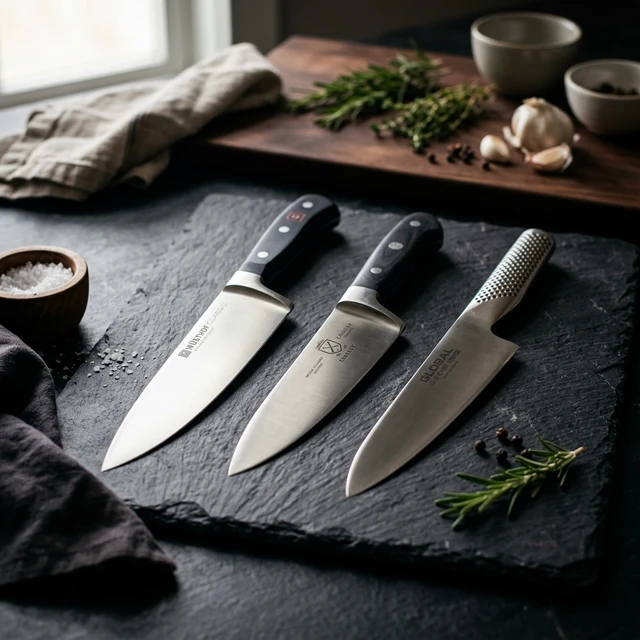
Table of Contents
Affiliate Disclosure: We may earn a commission if you purchase through our links. This doesn't affect our reviews.
Listing check: Amazon titles and photos change. Confirm the steel, length, and model named on this page match the listing before you buy — this is a research note from Nora Whitfield, not a copy of the Amazon product copy.
Affiliate Disclosure: Kitchenware Authority is an Amazon Associate. We earn from qualifying purchases at no extra cost to you. This helps support our independent research and chef-reviewed guides.
The short verdict: for most buyers, Zwilling Pro is the better default choice. Its curved half bolster is friendlier for a pinch grip, the heel stays exposed so it sharpens cleanly across a lifetime of use, and the rounded belly suits the rock chopping that most home cooks actually do. The one case where Wusthof wins is when you specifically want a traditional full bolster and a more planted, secure, old-school German feel — that is the Wusthof Classic, and no Zwilling line reproduces it. Pick by grip and cutting style, not by brand name.
Wusthof and Zwilling are the two German knife brands most home cooks compare first. Both are rooted in Solingen, both make forged German chef knives, and both sit in the premium-but-still-practical price tier for serious home kitchens. The reason this comparison is genuinely hard is that the two companies use very similar steel, hit very similar hardness targets, and charge very similar prices — so the real differences live in the bolster, the handle, the blade profile, and which product line you pick within each brand.
If this is your first serious chef knife, also read our first chef knife buying guide. The best choice depends less on brand prestige and more on how you hold the knife, how you cut, and whether you prefer a full or half bolster.
Quick Comparison: Wusthof Classic vs Zwilling Pro
These two flagship lines are what most shoppers actually weigh against each other.
| Feature | Wusthof Classic | Zwilling Pro |
|---|---|---|
| Best for | Traditional German-knife feel | Modern grip and rock chopping |
| Construction | Forged, full tang | Forged, full tang |
| Steel | X50CrMoV15 | Special formula (1.4116-class) |
| Hardness | About 58 HRC | About 57 HRC |
| Edge angle | 14 degrees per side | 15 degrees per side |
| Bolster | Full bolster | Curved half bolster |
| Cutting style | Push cuts, tap chopping, secure controlled work | Rock chopping, pinch grip, varied prep |
| Sharpening heel | Full bolster can complicate sharpening over time | Open heel is easier to sharpen fully |
| Main downside | Full bolster gets in some cooks' way | Less traditional hand feel |
Verdict by User Type
If you want a one-line answer for your situation, use this table.
| You are… | Best pick | Why |
|---|---|---|
| A home cook buying one lifelong knife | Zwilling Pro | Half bolster, pinch-grip friendly, easiest to sharpen at the heel |
| A traditionalist who loves a full bolster | Wusthof Classic | Full bolster, planted secure feel, classic German profile |
| An enthusiast who wants the nicest handle | Wusthof Classic Ikon | Contoured handle, half bolster, refined balance and end cap |
| On a budget | Wusthof Gourmet or Zwilling Twin Signature | Stamped, lighter, much lower price for the same steel |
| Buying a gift | Wusthof Classic | Recognized name, gift-boxed, broad traditional appeal |
| A rock chopper | Zwilling Pro or Four Star | Rounded belly and curved bolster suit a rocking motion |
| A push or tap cutter | Wusthof Classic or Ikon | Steadier, straighter belly for controlled downward cuts |
Terms That Decide This Purchase
A full bolster is the thick metal transition between the blade and handle. It protects the fingers and adds a traditional German-knife feel, but it can make sharpening the heel more difficult as the blade is ground down over years of use.
A half bolster leaves more of the heel exposed. That makes pinch gripping and full-edge sharpening easier, which is why many modern chef knives use this design.
PEtec (Precision Edge Technology) is Wusthof's computer-controlled sharpening process. It is not a steel type — it is how Wusthof puts a consistent factory edge on the blade.
Friodur is Zwilling's ice-hardening process. It is also not a steel type. It is a hardening and tempering process meant to improve durability and corrosion resistance.
X50CrMoV15 is the stainless steel Wusthof forges its Classic and Gourmet lines from. The "50" denotes roughly 0.5% carbon, and the alloying elements (chromium, molybdenum, vanadium) add corrosion resistance, toughness, and wear resistance. Zwilling's "special formula" steel is a closely related German knife steel in the same 1.4116 class, with very similar performance characteristics.
HRC is the Rockwell hardness rating. Higher numbers usually mean better edge holding but less toughness. Wusthof and Zwilling are close enough in hardness that grip, profile, and maintenance matter more than the 1-point HRC difference.
Wusthof Line-by-Line: Classic vs Ikon vs Gourmet
Wusthof's range is not one knife — it is several lines built around the same steel but with very different construction and feel. Knowing which line you are looking at prevents overpaying or buying the wrong build.
Wusthof Classic
The flagship and the reference "German knife" most people picture. Forged from X50CrMoV15, hardened to about 58 HRC, and sharpened with PEtec to roughly 14 degrees per side. The full bolster and triple-riveted POM handle give a secure, planted feel with a clear stopping point for your index finger. It is heavier in hand than the Zwilling Pro, which some cooks love and others find tiring over long prep. Best for traditionalists, push cutters, and anyone who wants the bolster as a finger guard.
Wusthof Classic Ikon
Same forged X50CrMoV15 steel, same ~58 HRC, same PEtec 14-degree edge — the differences are almost entirely ergonomic. The Ikon has a contoured, more rounded POM handle, a half bolster (so the heel is fully exposed and sharpenable, just like the Zwilling Pro), and a stainless steel end cap that shifts balance slightly forward. Best for cooks who want Wusthof steel with a more modern, comfortable handle and an open heel that avoids the Classic's long-term sharpening drawback.
Wusthof Gourmet
Wusthof's stamped line — cut from a sheet of X50CrMoV15 rather than drop-forged, then PEtec-sharpened to about 14 degrees per side. Hardness lands around 57–58 HRC, in the same ballpark as the forged lines, but the blade is thinner, lighter, and has no full bolster. It is meaningfully cheaper. Best as an entry point to Wusthof steel, a lighter backup knife, or a budget pick for someone who wants the alloy without paying for forging. The tradeoff is less heft, less balance-forward feel, and a slightly less robust spine and tang than the Classic.
Zwilling Line-by-Line: Pro vs Four Star vs Twin Signature
Zwilling's lineup runs parallel to Wusthof's: a modern flagship, a classic forged line, and a stamped value line, all built around the same special-formula steel and Friodur hardening.
Zwilling Pro
The line that best expresses Zwilling's modern design. Forged, Friodur ice-hardened to about 57 HRC, sharpened to roughly 15 degrees per side. The defining feature is the curved bolster combined with an ergonomic polymer handle — the curved bolster lets you pinch-grip comfortably and use the full heel of the blade. The belly is more rounded than the Wusthof Classic's, which makes it feel more natural for rock chopping. The reference 8-inch model is the 38401-203. Best for pinch grippers, rock choppers, and cooks who want the easiest long-term sharpening of any line in this comparison.
Zwilling Four Star
Launched in 1976 and still Zwilling's classic forged workhorse. Same special-formula steel, same Friodur hardening, ~57 HRC, 15-degree edge. The differences from Pro are the full bolster and the synthetic handle with a stainless steel cap bonded to the front — a more traditional feel than Pro, with the same durability. Because it has a full bolster, the heel-sharpening consideration is closer to the Wusthof Classic than to the Zwilling Pro. Four Star is widely imitated, so buy from an authorized retailer to avoid lookalikes. Best for cooks who want Zwilling's classic build and do not mind the full bolster.
Zwilling Twin Signature
Zwilling's stamped value line, still carrying the special-formula steel and Friodur hardening at ~57 HRC with a 15-degree edge. Lighter, with a molded handle and no full bolster, at a much lower price than Pro or Four Star. It is a legitimate budget entry into real Zwilling steel. Note the brand distinction: Twin Signature carries the Zwilling twin logo, while Henckels International carries a single-person logo and is a separate, lower tier — do not confuse the two when comparing prices.
Steel and Hardness, Compared
The honest summary: at the steel level, these knives are more alike than different. All six lines use a German martensitic stainless in the same family, hardened into a narrow 57–58 HRC window. That narrow spread is intentional — it targets the sweet spot for kitchen cutlery, balancing edge retention against the toughness needed so a blade does not chip on a bone or a cutting board mishap.
| Line | Steel | Hardness | Edge angle | Construction | Bolster |
|---|---|---|---|---|---|
| Wusthof Classic | X50CrMoV15 | ~58 HRC | 14° per side (PEtec) | Forged | Full |
| Wusthof Classic Ikon | X50CrMoV15 | ~58 HRC | 14° per side (PEtec) | Forged | Half |
| Wusthof Gourmet | X50CrMoV15 | ~57–58 HRC | 14° per side (PEtec) | Stamped | Minimal |
| Zwilling Pro | Special formula (1.4116-class) | ~57 HRC | 15° per side | Forged | Curved half |
| Zwilling Four Star | Special formula (1.4116-class) | ~57 HRC | 15° per side | Forged | Full |
| Zwilling Twin Signature | Special formula (1.4116-class) | ~57 HRC | 15° per side | Stamped | Molded |
Two small but real differences are worth knowing. First, Wusthof's PEtec edge is a touch more acute (about 14 degrees per side versus Zwilling's 15), which can make a fresh Wusthof feel slightly sharper out of the box, at the cost of being marginally more delicate. Second, Zwilling's Friodur ice-hardening is designed to refine the steel's microstructure for corrosion resistance and toughness. Neither difference is large enough on its own to settle the purchase — but together with the bolster and handle, they explain why the two brands feel different in hand despite near-identical raw materials.
In normal home cooking, the steel difference is not the deciding factor. Both brands are tough, stainless, easy to maintain, and more forgiving than many thin Japanese knives. If you want to understand steel tradeoffs in more detail, our knife steel guide explains hardness, toughness, and edge retention.
Blade Shape and Cutting Style
This is where the Wusthof vs Zwilling decision becomes practical, and it is driven by the bolster and belly more than by the alloy.
Wusthof Classic has a traditional German chef-knife profile with a full bolster and a controlled, substantial feel. It works well for push cuts, tap chopping, and cooks who want the confidence of a physical finger guard. The Ikon shares that cutting character but is more comfortable to hold for longer sessions, and the Gourmet cuts the same way at a lighter weight.
Zwilling Pro has a curved half bolster and a blade profile that feels more natural for rock chopping. The open heel also makes it easier to sharpen the full edge over time. The Four Star is similarly capable but with a straighter, more traditional handle feel and a full bolster, and the Twin Signature brings the same Pro-family profile at a lighter stamped weight.
If you chop herbs by keeping the tip near the board and rocking the handle, Zwilling Pro will probably feel more natural. If you make straight downward cuts through onions, carrots, and potatoes, Wusthof Classic will feel steady and predictable. Neither style is wrong — they just reward different muscle memory.
Handle and Bolster
The handle is the most important ergonomic difference, and it is where you should spend the most attention in a store or when comparing returns-friendly retailers.
Wusthof Classic uses a traditional triple-riveted synthetic handle with a full bolster. The bolster gives your index finger a clear stopping point, which some cooks like for security. The tradeoff is that the bolster can get in the way of a relaxed pinch grip and can make the heel harder to sharpen after years of use. The Classic Ikon solves both of those objections with its contoured handle and half bolster while keeping the same steel.
Wusthof Classic 8-Inch Chef's Knife
Zwilling Pro uses a curved handle and half bolster. That design encourages a pinch grip and leaves the heel more open for sharpening. It feels less old-school than the Wusthof Classic, but many home cooks find it more comfortable for longer prep sessions. The Four Star sits in between — a full bolster like the Classic, but with Zwilling's synthetic, stainless-capped handle.
Zwilling Pro 8-Inch Chef's Knife
Sharpening and Maintenance Comparison
Hand wash all of these lines. Do not put any of them in the dishwasher — detergent, heat, and movement will dull the edge and can damage the handle and the rivets. Hone regularly with a steel or ceramic honing rod, and sharpen when honing no longer brings the edge back. For most home cooks that means every few months, but board material and cooking volume matter far more than the calendar.
The bolster design is what actually differentiates long-term maintenance across the six lines:
- Wusthof Classic (full bolster): Honing is unaffected. Whetstone and pull-through sharpening work normally, but over years of grinding, the full bolster can sit slightly proud of the shrinking edge and leave a small unsharpened lip at the heel. A professional can grind the bolster flush, or you can sharpen slightly more often to keep the heel in line.
- Wusthof Classic Ikon (half bolster): The heel stays fully exposed, making the Ikon the easiest Wusthof to sharpen across the whole edge.
- Wusthof Gourmet (minimal bolster, stamped): Easy to sharpen, but the thinner stamped blade removes metal faster on a coarse stone — use a fine grit and a light hand.
- Zwilling Pro (curved half bolster): The easiest of the Zwilling lines to sharpen heel-to-tip, because the curved bolster stays out of the way of the stone.
- Zwilling Four Star (full bolster): Same long-term heel consideration as the Wusthof Classic.
- Zwilling Twin Signature (molded bolster, stamped): Easy and light, with the same gentle-sharpen caveat as the Gourmet.
For technique, our kitchen knife sharpening guide covers whetstones, pull-through sharpeners, honing rods, and when each method makes sense. A good rule: pair either brand with a soft wood or end-grain cutting board — glass, stone, and ceramic boards will dull even 58 HRC steel quickly regardless of which logo is on the blade.
Price and Value
Both brands usually sit in the premium home-cook tier for their forged flagship lines, with the stamped lines (Gourmet, Twin Signature) running meaningfully lower. Street prices change often, so this guide avoids fixed price claims. In general, Wusthof Classic and Zwilling Pro are both worth comparing against the broader field of chef knives under $200.
Zwilling is often more promotional, so you may see stronger sales on individual knives or sets. Wusthof pricing is often steadier. Do not buy a large block set from either brand unless you know you will use every knife — a chef knife, paring knife, bread knife, and honing rod cover most kitchens. If budget is the deciding factor, the stamped lines (Wusthof Gourmet, Zwilling Twin Signature) deliver the same steel family at a fraction of the flagship price.
Which Line Should You Buy?
For Wusthof, the Classic line is the default recommendation if you want the traditional full-bolster feel. Classic Ikon is the upgrade if you want the same steel with a more comfortable handle and a half bolster that solves the Classic's sharpening drawback. Gourmet is the budget entry for the same alloy in a lighter stamped build.
For Zwilling, the Pro line is the default recommendation — it is the line that best expresses the modern half-bolster design and is the easiest to maintain. Four Star is the choice if you prefer Zwilling's classic forged feel with a full bolster. Twin Signature is the value entry. Be careful not to confuse Zwilling with Henckels International when comparing prices; Henckels can be a fine budget line, but it is not the same premium product tier.
Bottom Line
For most home cooks choosing between Wusthof vs Zwilling, Zwilling Pro is the slightly easier recommendation because the half bolster is more pinch-grip friendly and easier to sharpen at the heel. It feels more modern without giving up the forged German-knife durability people expect, and its rounded belly suits the way most home cooks actually chop.
However, that does not make Wusthof worse. Wusthof Classic is the better pick if you like a full bolster, a more traditional handle, and a knife that feels planted and secure. The Ikon gives you the best of both worlds inside the Wusthof family — the same steel and edge with a half bolster and a more refined handle — and Gourmet is the smart way to buy Wusthof steel on a budget. Plenty of cooks prefer that extra guard and heft, especially when moving from inexpensive stamped knives to a premium chef knife.
Wusthof vs Zwilling: Which Should You Buy?
Buy Wusthof Classic if you want a traditional German chef knife, prefer a full bolster, like a secure finger guard, and use push cuts or tap chopping more than rock chopping. Choose Classic Ikon within the Wusthof family if you want the same build with a more comfortable handle and an easier-to-sharpen half bolster.
Buy Zwilling Pro if you use a pinch grip, rock chop herbs and aromatics, want a more modern handle shape, and prefer an open heel that is easier to sharpen. Choose Four Star for Zwilling's classic forged feel, or Twin Signature for the same steel at a budget price.
Both are legitimate long-term knives, and the stamped lines on both sides are legitimate budget choices. The real mistake is buying based only on brand name. Match the line to your grip, cutting style, and budget, then maintain it properly, and either brand will outlast most of the other tools in your kitchen.
Related Guides: Still deciding how much to spend? Read are expensive kitchen knives worth it?. For Japanese alternatives, see our best Japanese knives for home cooks or our Shun vs Miyabi breakdown. Comparing across budgets? Our best chef knives under $200 rounds up both brands alongside competitors.
Sources
Nora Whitfield
Writer, Kitchenware Authority
Nora Whitfield writes Kitchenware Authority's reviews and buying guides. Every knife, pan, and appliance is vetted against maker specifications, materials and safety documentation, and the long-run experience verified home cooks report — not first-hand lab tests.
Upgrade Your Kitchen Skills
Get research-based gear reviews, maintenance tips, and buying guides from the Kitchenware Authority desk.
No spam. Research notes from Nora Whitfield, not invented reader counts.