Best Nonstick Pan Without Teflon: Safe Alternatives That Actually Work
Teflon-free nonstick pans that really release food: ceramic picks from Caraway and GreenPan, plus seasoned carbon steel and cast iron, with honest trade-offs.

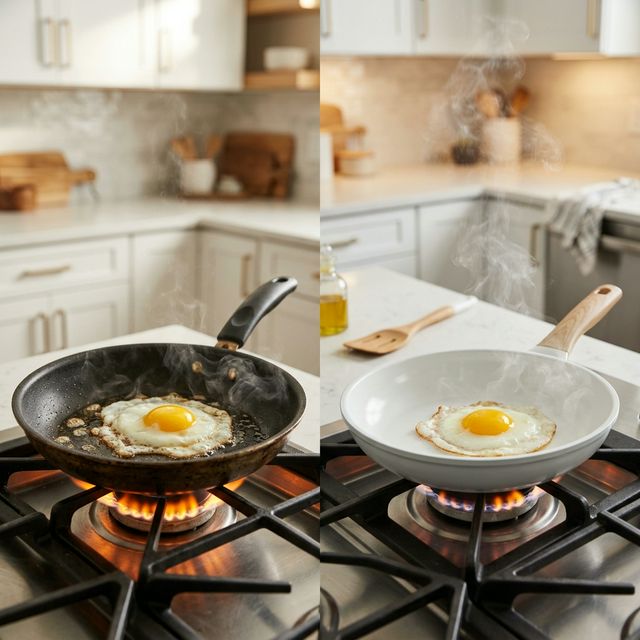
Table of Contents
Affiliate Disclosure: We may earn a commission if you purchase through our links. This doesn't affect our reviews.
Listing check: Amazon titles and photos change. Confirm the steel, length, and model named on this page match the listing before you buy — this is a research note from Nora Whitfield, not a copy of the Amazon product copy.
If you want eggs that slide and crepes that release — without a PTFE (Teflon) coating — you have more good options in 2026 than at any point in the last decade. Ceramic-coated pans have matured, and seasoned bare-metal pans remain the most durable "nonstick" surfaces ever made. This guide synthesizes manufacturer specifications, owner-review consensus, and public-health sources to help you pick the right one for how you actually cook.
We'll be direct about one thing up front: no coating is magic. Every nonstick surface is a trade-off between release, durability, searing power, and maintenance. The best pan for you depends on which of those you're willing to give up.
Why people skip Teflon in the first place
PTFE (polytetrafluoroethylene), best known by the brand name Teflon, is an extremely effective release coating. The health conversation around it has two separate threads that often get tangled:
The manufacturing chemical. PFOA, historically used in PTFE production, is a genuine public-health concern — the EPA's PFAS program tracks it as part of the broader "forever chemicals" family, and the agency's 2010/2015 PFOA Stewardship Program drove major manufacturers to eliminate PFOA from emissions and products in the U.S. by 2015. PFOA was also classified as carcinogenic to humans (Group 1) by the IARC in Volume 110 of its monographs. Importantly, that classification concerns PFOA exposure broadly (contaminated water, industrial settings) — not the finished pan on your stove. Modern PTFE cookware made after the stewardship-program transition is not made with PFOA.
The coating in your kitchen. The American Cancer Society's summary on Teflon and PFOA notes that PTFE itself is inert and not known to cause cancer, and that the main practical risk from a PTFE pan arises when it's seriously overheated — an empty pan left on high heat can release fumes that cause transient flu-like symptoms ("polymer fume fever"), and fumes at much lower levels can kill pet birds, whose respiratory systems are unusually sensitive.
So the honest framing is: intact, normally-used PTFE pans are considered low-risk by mainstream health authorities, while overheated PTFE is a real (and avoidable) hazard. Still, plenty of cooks reasonably prefer to avoid fluoropolymer coatings entirely — for the fume margin, the environmental persistence of PFAS chemistry, or simply faster replacement cycles. If that's you, the alternatives below are legitimately good, not a compromise you have to talk yourself into.
The three credible paths to nonstick without PTFE
1. Ceramic sol-gel coatings
Brands like Caraway and GreenPan coat aluminum bodies with a sol-gel ceramic layer — typically derived from silica — rather than fluoropolymers. GreenPan describes its Thermolon coating as a mineral-based finish manufactured without PFOA, and the company was an early mover in the category. Ceramic releases beautifully when new, handles eggs and fish well, and doesn't carry the overheat-fume concern of PTFE.
The trade-off is longevity. Ceramic coatings lose release faster than PTFE — often within a couple of years of regular use — and there's no reliable way to re-coat a pan at home. If you go this route, read how long ceramic pans actually stay nonstick so your expectations match reality, and see our deeper dive on the best ceramic nonstick pans.
2. Seasoned carbon steel
A carbon steel pan with a good patina of polymerized oil is what restaurant kitchens have used for generations to release eggs, potatoes, and fish at volume. It's effectively maintenance-based nonstick: the seasoning improves with use rather than wearing out, the pan takes metal spatulas, and it sears far harder than any coated pan can. The upfront cost is effort — an initial seasoning, some rust vigilance, and hand washing.
Our full carbon steel pan roundup covers the category, and if you've never seasoned one, our step-by-step carbon steel seasoning guide walks through the whole process.
3. Seasoned cast iron
Functionally the same idea as carbon steel with more thermal mass: slower to heat, slower to cool, nearly indestructible. A well-maintained skillet releases cornbread, fritters, and fried eggs cleanly. The Lodge cast iron care guide covers the maintenance basics — dry promptly and re-oil to prevent rust.
If you're weighing the two bare-metal routes, our cast iron vs stainless steel comparison and carbon steel vs cast iron breakdown cover the differences in detail.
Our picks
Best overall for most cooks: Caraway Fry Pan
Caraway built its brand on PTFE-free construction, and its frying pan is the most broadly useful option here for the average household — ceramic coating, an aluminum body that heats evenly, a comfortable handle, and a size (around 10 inches) that suits most burners. Owner reviews converge on the same picture: excellent release for the first year-plus, straightforward cleanup, and styling people genuinely keep on display. The recurring criticism is also consistent — the coating is not a buy-it-for-life surface, and aggressive heat or dishwasher cycles shorten it.
Treat it as a consumable you'll replace every few years, not a heirloom, and it earns its price.
Best for: everyday eggs, delicate fish, and cooks who want nonstick performance with zero maintenance and no fluoropolymer coating.
Best established ceramic option: GreenPan
GreenPan has been making ceramic-coated cookware longer than nearly anyone and offers it across a wide range of lines and price points — which is both a strength (replacement availability, matching sets) and a shopping hazard (line names and specs change often, so check the current model's details before buying). Reviewers consistently praise the release quality when new and the lighter weight versus bare-metal options, with the same ceramic caveat: lifespan is measured in years, not decades.
Best for: budget-to-midrange ceramic buyers who want brand longevity and easy parts of the ecosystem, and anyone building toward a full ceramic cookware set.
Best traditional nonstick: de Buyer Mineral B carbon steel pan
A French-made carbon steel pan with a bare, naturally seasoned surface (de Buyer ships it with a protective beeswax coating you wash off before first seasoning). This is the closest thing to a permanent nonstick pan: no coating to scratch, safe with metal utensils, oven-safe to any temperature you'd realistically cook at, and it improves for decades. The cost is the learning curve — it needs seasoning, it will discolor, and acidic dishes are better made elsewhere. Very high-heat searing and stir-fry work are its strengths; for a dedicated stir-fry shape, see our carbon steel wok picks.
Best for: cooks willing to do light maintenance in exchange for a pan that never needs replacing.
Best budget no-coating pick: Lodge cast iron skillet
The default answer for inexpensive, coating-free, naturally releasing cookware. A pre-seasoned Lodge skillet costs less than most ceramic pans, works on induction and in the oven or over a campfire, and outlives several generations of coated pans. Downsides are weight, slower heat response, and uneven heating on the stovetop until it's fully preheated — our cast iron skillet roundup and seasoning guide cover how to get the most from one.
Best for: durability-per-dollar, cornbread, frying, and anyone who wants one pan that will never be "worn out."
What about stainless steel?
Stainless isn't nonstick, but it's the other common PTFE-free answer once you learn to manage temperature — preheat properly, add oil at the right moment, and most sticking disappears. It's the most durable cooking surface of all and the best choice for pan sauces and acidic dishes. Our explainer on why food sticks to stainless steel covers the technique, and our All-Clad D3 skillet review is the classic example of the category.
For many households the real answer is a pair: stainless or bare metal for searing and sauces, one ceramic pan for eggs and delicate items.
How to make any of these last
Regardless of which path you choose, the failure modes are the same and they're all behavioral:
- Don't preheat empty on high. Hard on ceramic, risky with PTFE, pointless with cast iron.
- Use fat anyway. "Nonstick" means food releases, not that oil is optional — a thin film of fat dramatically extends ceramic coating life.
- Hand wash coated pans. Detergent and abrasive pads are the fastest way to strip a sol-gel coating.
- Avoid thermal shock. A hot pan under cold water can warp aluminum bodies and crack coatings.
- Cook on low-to-medium. Ceramic releases best at moderate temperatures; bare metal can take the high heat instead.
For the health questions in more depth — including the science on ceramic coatings specifically — see our ceramic vs Teflon safety overview and the ceramic nonstick care guide. If you're keeping a PTFE pan and just want to use it safely, our nonstick pan safety guide has the specifics.
Frequently asked questions
Is "Teflon-free" the same as "PFAS-free"? Not automatically. Teflon is one specific PTFE brand, and a pan can be free of PTFE while still using other fluorinated processing aids. If avoiding PFAS as a class matters to you, look for an explicit "PFAS-free" claim from the manufacturer rather than just "PFOA-free," which nearly every modern pan — including PTFE ones — can accurately make.
Do ceramic pans really stop being nonstick? Yes, eventually — the coating is not replenishable. With moderate heat, some fat, and hand washing, reviewers commonly report a few years of good performance; dishwashers and high heat shorten that considerably. Our ceramic lifespan article covers the variables.
What's the safest nonstick pan for pet birds? Bird owners have the least margin for error, because avian respiratory systems are sensitive to fumes that don't affect humans — the American Cancer Society specifically flags overheated PTFE as a bird hazard. Ceramic, seasoned carbon steel, and cast iron all remove that specific concern entirely.
Can I get a nonstick pan that lasts forever? Only if it's bare metal. Seasoned carbon steel and cast iron are the only options whose nonstick property is created by you and repairable at home, rather than applied at a factory and gradually consumed.
Are these picks induction-compatible? Carbon steel and cast iron are, inherently. Ceramic pans depend on the base construction — most quality ceramic lines use magnetic stainless bases and are induction-ready, but confirm the specific model's listing before buying, since base construction varies by line.
The bottom line
For most people, Caraway is the easiest good answer: real nonstick performance, no PTFE, minimal maintenance. GreenPan is the established alternative at friendlier prices across more lines. If you'd rather buy once and never replace, seasoned carbon steel (de Buyer Mineral B) or cast iron (Lodge) is nonstick the old way — earned with a little care and kept for decades. And whatever you choose, the pans above all answer the question that matters: you can absolutely cook eggs without Teflon.
Nora Whitfield
Writer, Kitchenware Authority
Nora Whitfield writes Kitchenware Authority's reviews and buying guides. Every knife, pan, and appliance is vetted against maker specifications, materials and safety documentation, and the long-run experience verified home cooks report — not first-hand lab tests.
Upgrade Your Kitchen Skills
Get research-based gear reviews, maintenance tips, and buying guides from the Kitchenware Authority desk.
No spam. Research notes from Nora Whitfield, not invented reader counts.