How to Choose Your First Professional Chef's Knife
Don't buy a 20-piece knife block. Here is why you only need three knives, and how to pick the most important one.

verified Chef Tested
Hands-on tested by professional chefs
toc Table of Contents
Affiliate Disclosure: We may earn a commission if you purchase through our links. This doesn't affect our reviews.
Stop Buying Knife Sets
The biggest mistake most home cooks make is buying a massive set of mediocre knives. Those 15-piece blocks look impressive on the counter, but most of those knives sit unused for years. The steak knives get pulled out twice a year. The “boning knife” gathers dust. The scissors break within months.
In reality, you do 90% of your kitchen work with a single knife: the Chef’s Knife (or Gyuto in Japanese). Professional cooks often carry their own knives to work, and a surprising number of them own just three.
The Three Essential Knives
1. Chef’s Knife (8-inch) — Your primary tool for 90% of cutting tasks. Dicing onions, mincing garlic, slicing meat, chopping herbs, cutting vegetables. This is the knife you should invest in.
2. Paring Knife (3.5-inch) — For small, handheld tasks that a chef knife is too large for: peeling fruit, deveining shrimp, trimming fat, hulling strawberries. A $10 paring knife works perfectly fine.
3. Bread Knife (10-inch) — The serrated edge grips crusty loaves without crushing the soft interior. Also useful for slicing tomatoes and leveling cake layers. A $15 bread knife does the job well since serrated edges rarely need sharpening.
Total cost for these three knives: as little as $80. That’s less than most knife block sets, and you’ll cut better with them.
German vs. Japanese: Two Schools of Cutlery
This is the first real decision you’ll face, and it fundamentally shapes your cooking experience.
German knives (Wüsthof, Henckels, Mercer) are like SUVs: heavy, durable, and can handle a lot of abuse. The blades are thicker with a wider edge angle (typically 15-20 degrees per side). They excel at rocking cuts and can handle hard squash, frozen foods, and even light bone work without chipping. The heavier weight does some of the cutting work for you.
Japanese knives (Shun, MAC, Tojiro, Global) are like sports cars: lightweight, incredibly precise, and require more care. The blades are thinner with a narrower edge angle (10-15 degrees per side). They slice through food with less effort and produce cleaner cuts that keep ingredients fresher. The tradeoff is fragility: thin edges can chip if you twist the blade or hit bone.
For a first knife, consider your cooking style. If you mainly cook Western food and want something forgiving, go German. If you do a lot of vegetable prep and want the sharpest possible edge, go Japanese. Either way, you’re upgrading massively from whatever came in that knife block.
How to Pick the Right Knife
Hold it before you buy it. The best knife is the one that feels like an extension of your hand. Visit a kitchen supply store and grip several options. Pay attention to:
- Balance: Does the weight distribute evenly between blade and handle, or does it feel front-heavy or handle-heavy? Neither is wrong, but you should find one that feels natural.
- Handle comfort: Can you grip it firmly for 30 minutes without fatigue? Try both pinch grip (thumb and forefinger on the blade) and handle grip (full hand on the handle).
- Weight: Lighter knives (5-7 oz) cause less fatigue during long prep sessions. Heavier knives (8-10 oz) let gravity assist your cuts.
Check the steel. Higher-carbon steels hold an edge longer but require more maintenance. Stainless steels are more forgiving but need sharpening more often. For a first knife, stainless or high-carbon stainless is the most practical choice.
Our Top Picks for Beginners
The Entry-Level Masterpiece: Tojiro DP
If you want a taste of Japanese performance without spending $200, the Tojiro is your best bet. It uses VG-10 “super steel” which takes and holds an excellent edge. The three-layer construction provides durability while keeping the cutting edge razor-sharp.
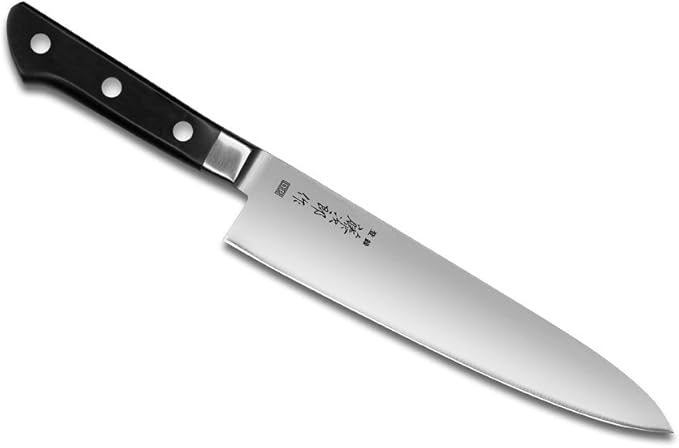
Tojiro DP 8" Gyuto
Tojiro
The best entry-level Japanese knife with VG10 core steel. Exceptional sharpness at an unbeatable price.
The Premium Starter: Shun Classic
If your budget allows, the Shun Classic delivers a noticeable step up in fit and finish. The Damascus-clad blade is beautiful, and the D-shaped handle provides a secure grip.
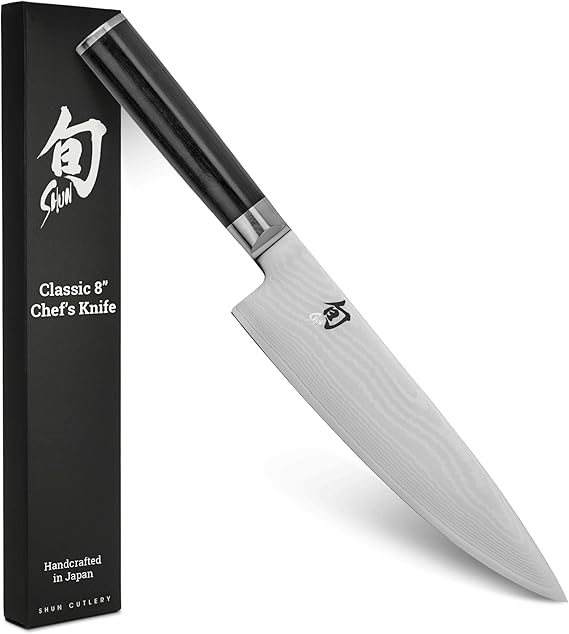
Shun Classic 8" Chef's Knife
Shun
A handcrafted Japanese chef's knife featuring 68 layers of Damascus cladding and a VG-MAX cutting core.
Caring for Your Investment
A good knife will last decades if you follow these basics:
- Hand wash only. Dishwashers destroy edges and handles.
- Use a cutting board. Never cut on glass, granite, or ceramic plates.
- Hone regularly. A honing steel realigns the edge before each use. It takes 30 seconds.
- Sharpen yearly. A whetstone or professional sharpening service restores the edge when honing no longer helps.
- Store properly. A magnetic strip, blade guard, or knife block protects the edge. Never toss it loose in a drawer.
Related Guides: Ready to learn about blade materials? Check our Japanese knife steel guide. Looking for budget recommendations? See our best Japanese knives under $100 and best chef knives under $200.
Marcus Chen
Senior Kitchen Equipment Editor• Culinary Institute of America graduate • Former sous chef, Atelier Crenn SF • 3 years experience in Kyoto kaiseki kitchens
Marcus Chen is a professional cook and kitchen equipment specialist with 15 years of hands-on experience across restaurant kitchens in San Francisco and Tokyo. He has worked alongside Japanese bladesmiths in Sakai and Seki, trained in classical French technique, and spent three years cooking kaiseki in Kyoto. At Kitchenware Authority, Marcus leads all product testing and editorial standards — every recommendation passes through his kitchen before it reaches yours.
Upgrade Your Kitchen Skills
Get chef-tested gear reviews, maintenance tips, and exclusive buying guides delivered to your inbox.
Join 15,000+ home cooks. No spam, ever.